
TIMELINE SUMMARY
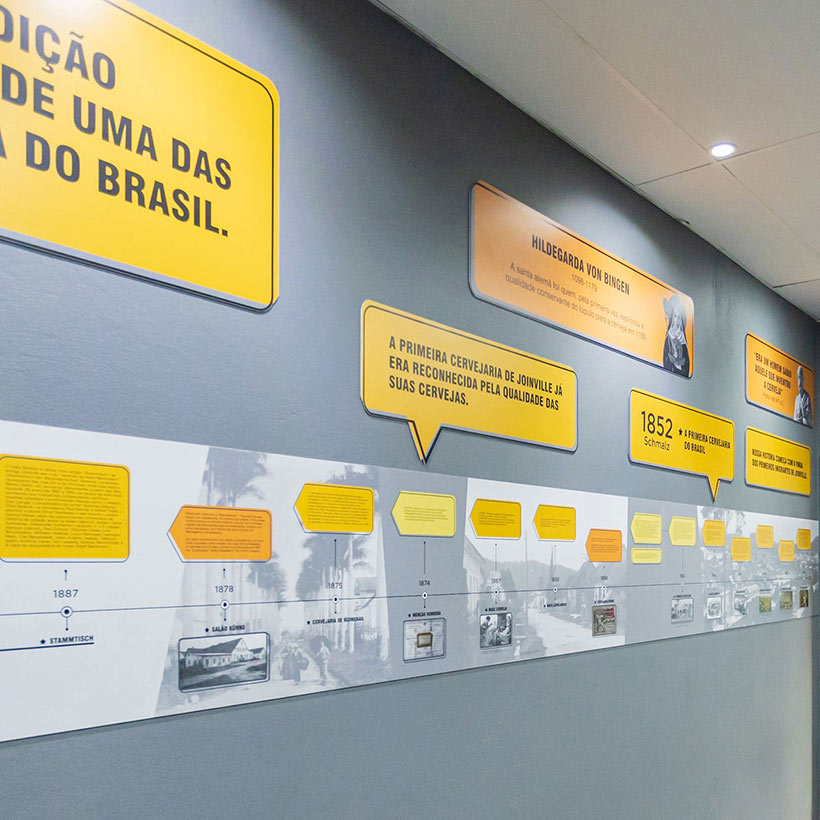
It all started in 1852, when brew master Albrecht Gabriel Schmalz arrived from Switzerland bringing the necessary brewing equipment.
As the climate in the region was unsuitable for growing barley, Schmalz used corn in the composition, a pre-Colombian formula from the Inca people. The malt was made by germinating the corn kernels in hot water. A wooden vat was used for clarification and action. Fermentation and maturation of the beer lasted almost two weeks. The water used to produce the beer was collected from the Mathias River, which today is canalized and runs through the city center. Cervejaria Schmalz was one of the first breweries established in Brazil. Some historians claim it was the first.
Over the years, other initiatives emerged in Joinville. By 1889, the city already had seven breweries in operation, a big number considering the size of the city at the time.
One of them was Cervejaria Tiede, which around 1928 was renamed Cervejaria Catharinense, brewing low-fermentation beers. Located on Rua XV de Novembro, it became the largest brewery in the state, producing seven beer labels of varying styles.
In 1942, Cervejaria Catharinense was reopened after the construction of its building was completed. In 1948, it was sold to Companhia Antarctica and ceased to be a craft brewery.
The city’s reputation for producing good beer, due to the quality of its water and its brew masters, led to Joinville’s Antarctica being recognized nationally and considered the best beer in Brazil between the 1970s and 1990s. However, in 1999, following a business decision, the Antarctica plant closed down for good, causing a seven-year interruption in the city’s brewing tradition. The resumption of brewing activity in Joinville only occurred in 2006, with the founding of OPA BIER.
Do you want to know a little more about the history of Joinville beer and OPA BIER? Then head to the Projection Room and settle into one of the armchairs.
BUTTON click to start the tour.
So? Ready to start the tour of our production line? Then follow the guide, remember to respect the warning signs, wear safety equipment, and only use your cell phone to take photos inside the factory when you are authorized to do so.
Click on NEXT to start the tour.
Hello! You are entering the largest beverage industry in Joinville and region. On the left, you’ll see our compound Syrup Factory. Click on NEXT to find out more about it.
SYRUP FACTORY
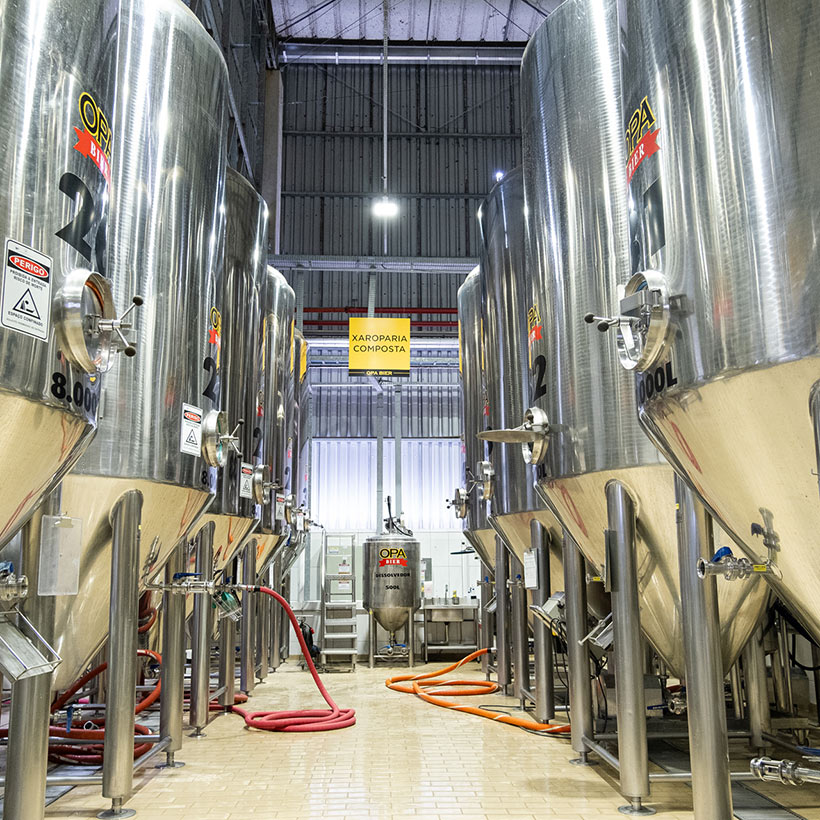
The Syrup Factory is the area where the syrups that serve as the basis for our lines of OPA Refri soft drinks and OPA Power energy drinks are produced and stored.
There are 9 tanks with a capacity of 8,000 liters each, connected to a 500-liter dissolver. It mixes the syrup with the carbonated water, which results in the soft drinks and energy drinks that will be bottled later. The plant has the capacity to fill 18 million liters of non- alcoholic drinks a year. This represents more than 50 million 350ml cans of soft drinks and energy drinks.
Click on NEXT.
TANKS

On the right you can see the huge stainless-steel tanks used for fermenting and maturing OPA BIER pure malt beers. Here there are 30 tanks arranged in three rows: six tanks of 10,000 liters, four of 20,000 liters and twenty tanks of 40,000 liters of capacity.
DID YOU KNOW: The largest tanks, with a capacity for 40,000 liters, are 9 meters high and weigh up to 46 tons each when full of beer. To install these 30 tanks in this 570m² area, it was necessary to make a foundation equivalent to that of a four-story building, such is the load that these structures exert on the ground. When all the tanks are full, the total weight is more than 1 million kilos!
A little further on you can see our mashing sector. Click on NEXT to find out more.
MASHING
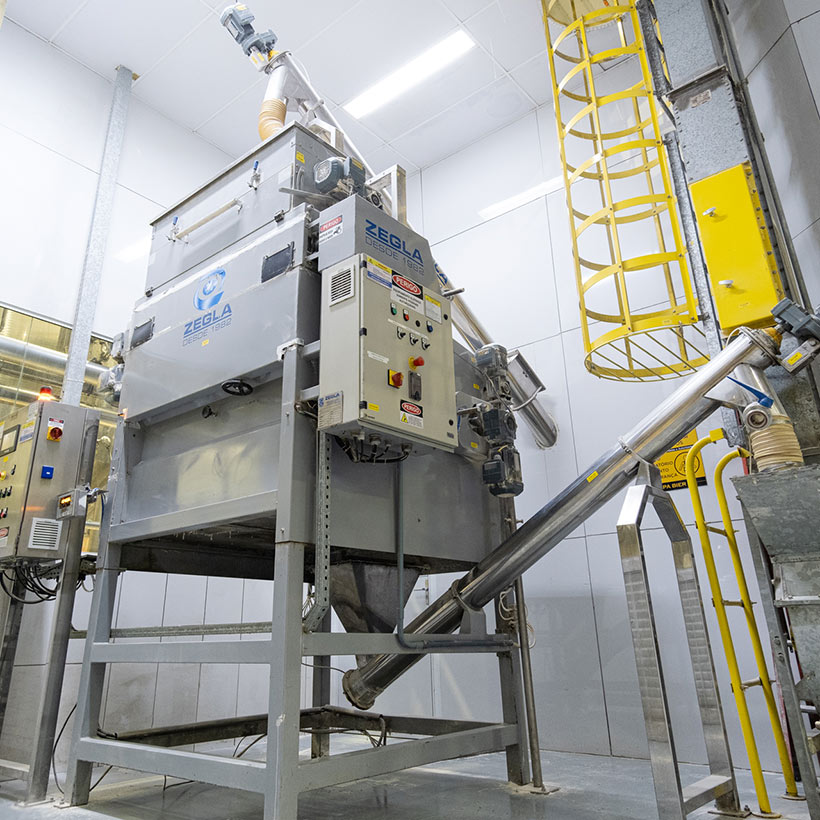
Mashing is where the starch in the malt is converted into fermentable sugars. OPA BIER’S mill has the capacity to grind 10 cycles of 1.8 tons of malt grains per day, for a total of 18 tons/day.
The sack of malt is lifted by a crane and the malt is deposited in the malt hopper. Once it has been milled, the mashing process begins. There are 4 process vats and 1 wort boiler, with a capacity of 10,000 liters of wort per cycle of 2 hours and 10 minutes.
DID YOU KNOW: Each sack of malt used at OPA BIER weights 1 ton and is 2.5 meters high. The sacks usually arrive from Guarapuava, a city in the state of Paraná. For this, they come by truck for about 400km to Joinville.
Mashing
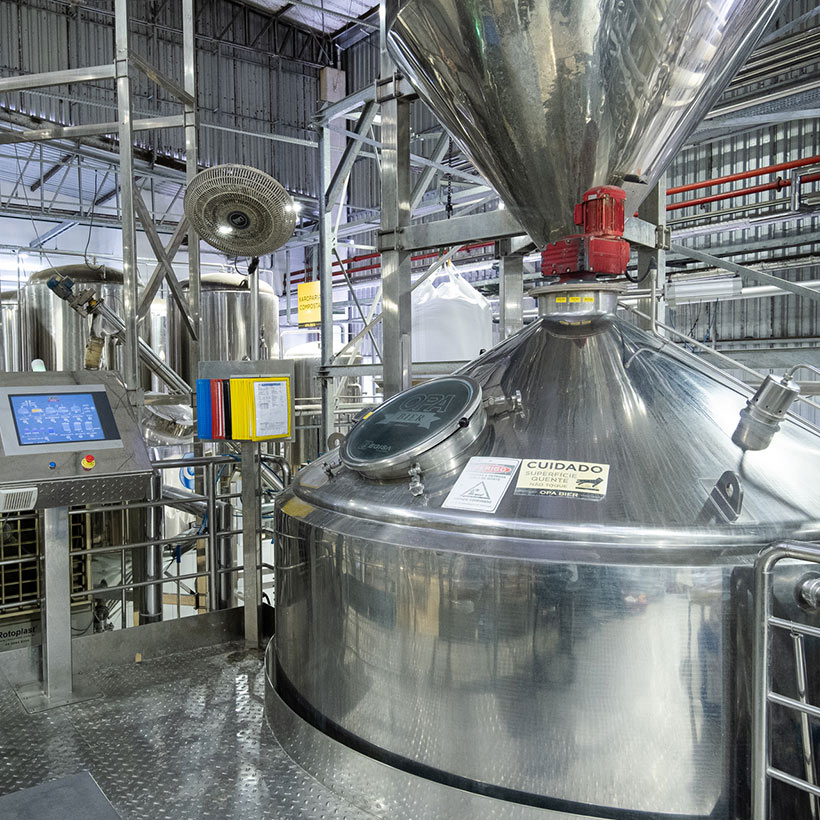
The crushed malt is placed in contact with previously heated water – the temperature varies according to the style of beer chosen. To produce Pilsen beer, the saccharification temperature is 70 degrees Celsius in approximately 60 minutes.
Wort filtration
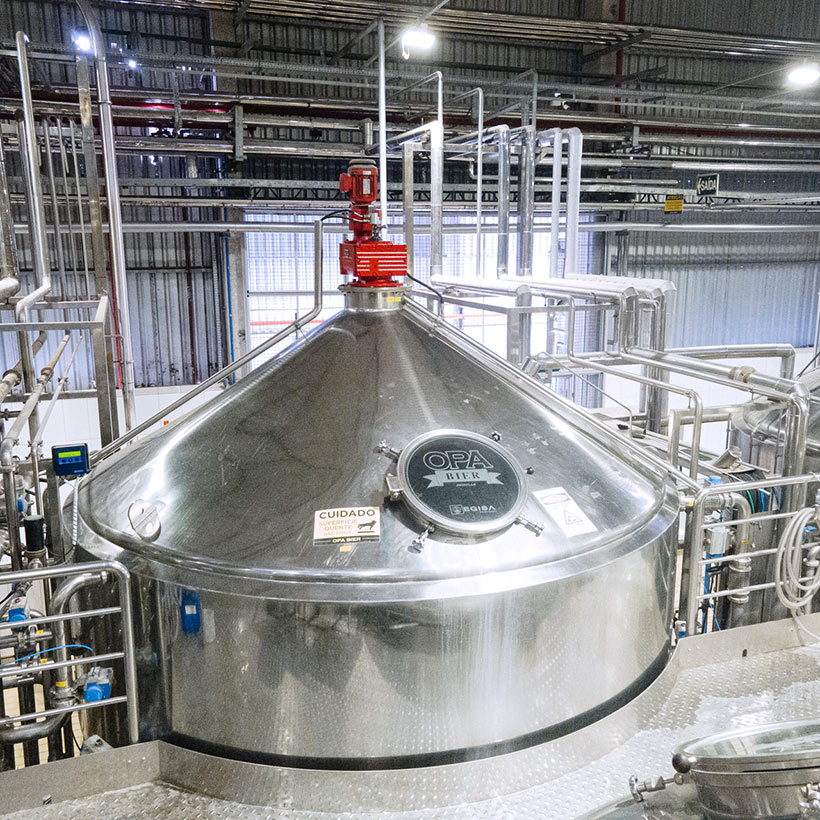
In the wort filtering vat, the liquid part called wort is separated from the malt husk. The liquid then goes to the boiling vat. The malt husk at this stage of the process serves as a filtering aid for the wort. At the end, the husk is transferred to an external silo.
DID YOU KNOW: At OPA BIER, malt pomace is transported to the OPA BIER Farm, where it is used as feed for the farm’s beef cattle. It is on this farm that OPA BIER grows hops that are fertilized with organic matter from the cattle. Once harvested, the hops return to the brewery to produce more beers. This circular economy exercise results in a delicious and sustainable beer.
Click on NEXT.
BOILER
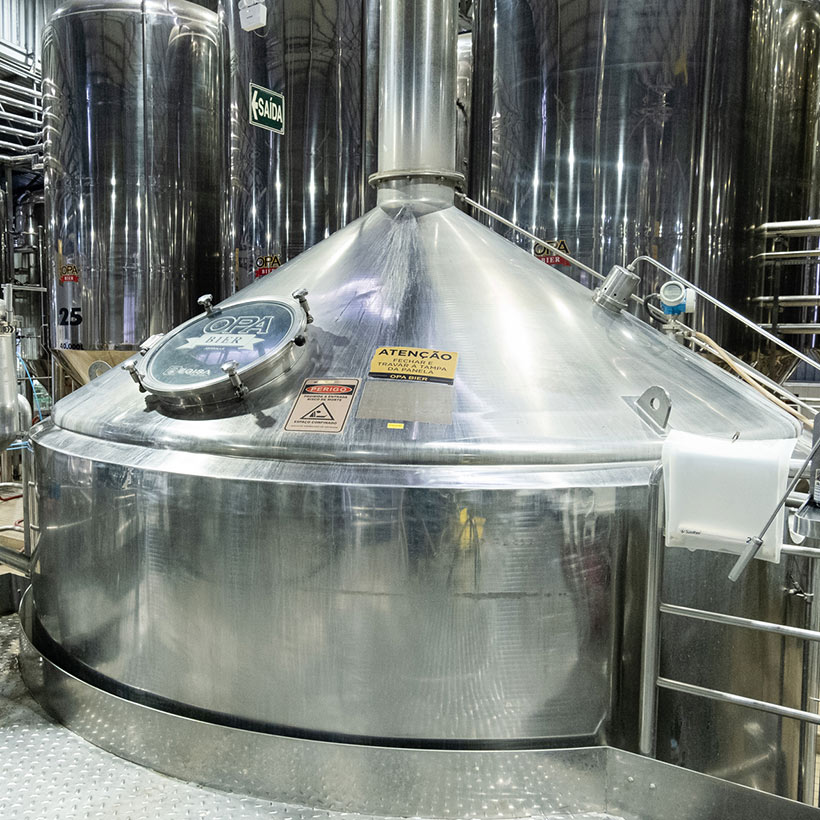
It’s time to boil the wort, a stage that lasts 60 minutes. During the boil, the wort is sterilized and evaporates, concentrating the sugars. This is also the time to add the hops, which give the beer its characteristic bitterness and aroma. The quantity of hops to be added varies according to the beer style being brewed. Beers with a more pronounced bitterness take more hops at this stage.
DID YOU KNOW: The hops used in OPA BIER beers come from several locations. Most of it comes from Germany or the United States. Some come from closer to home, about 7km from here, from the OPA BIER Farm. The hops used in Joinville Bier, the first OPA to use 100% Joinville hops in its recipe, are grown there.
Now look to the right again and click on NEXT.
FERMENTATION
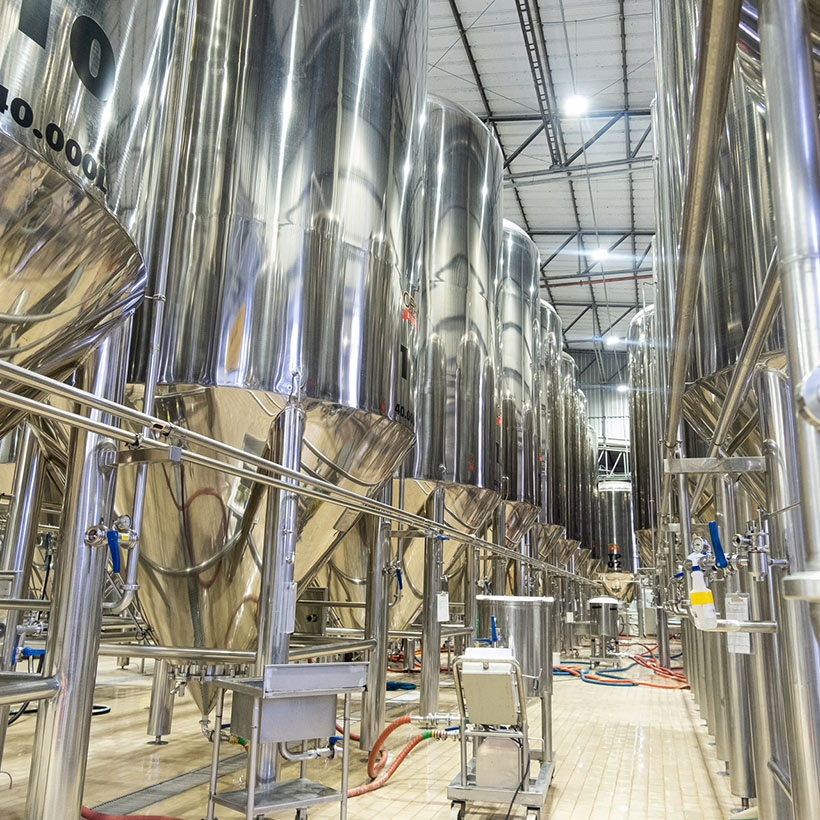
That’s it! After the entire mashing process the wort is cooled and sent to the tanks where the longest stage of its production begins: fermentation. Most beers need an average of 7 days to ferment. During fermentation, sugars are converted into alcohol and carbon dioxide. At the end of this process, the yeast needs to be removed and can be reused up to six times in the production of more beers.
DID YOU KNOW: At the end of each cycle, the yeast collected is analyzed in our laboratory, which will assess whether it will be reused or disposed of.
Click on NEXT.
CENTRIFUGATION
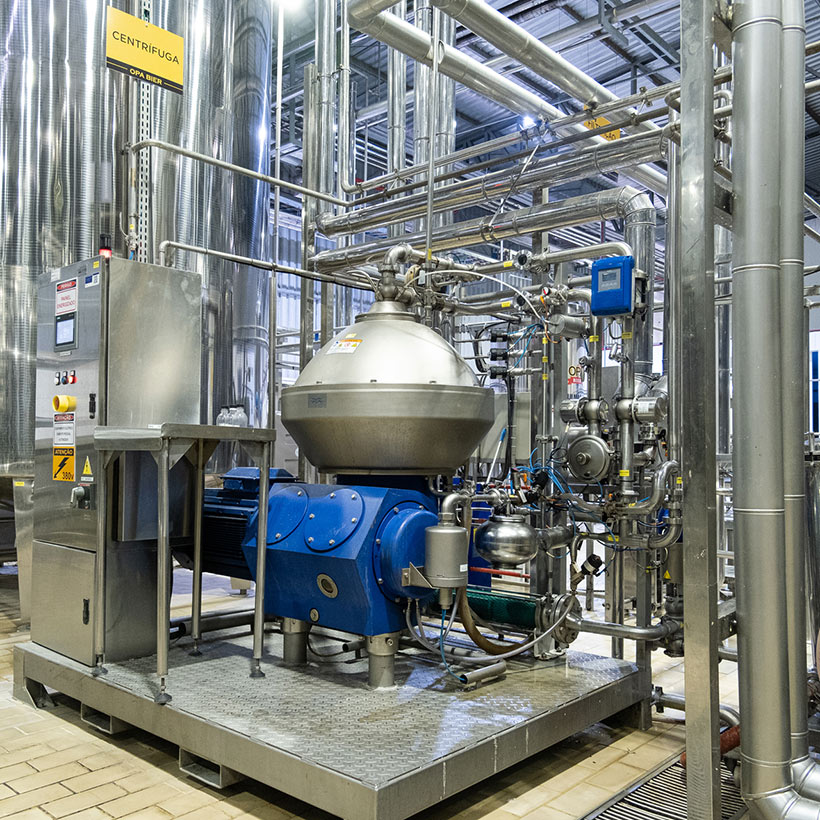
Once the fermentation stage is over and before the maturation stage begins, the beer is transferred to another tank of the same size, centrifuged to remove suspended yeast particles and other particulates, and cooled to sub-zero temperatures. This begins the beer’s maturation, a process that enhances the beer’s sensory characteristics, giving a finishing touch to its aromas and flavors. The maturation time varies from 7 to 40 days, depending on the beer style.
BEER FILTRATION
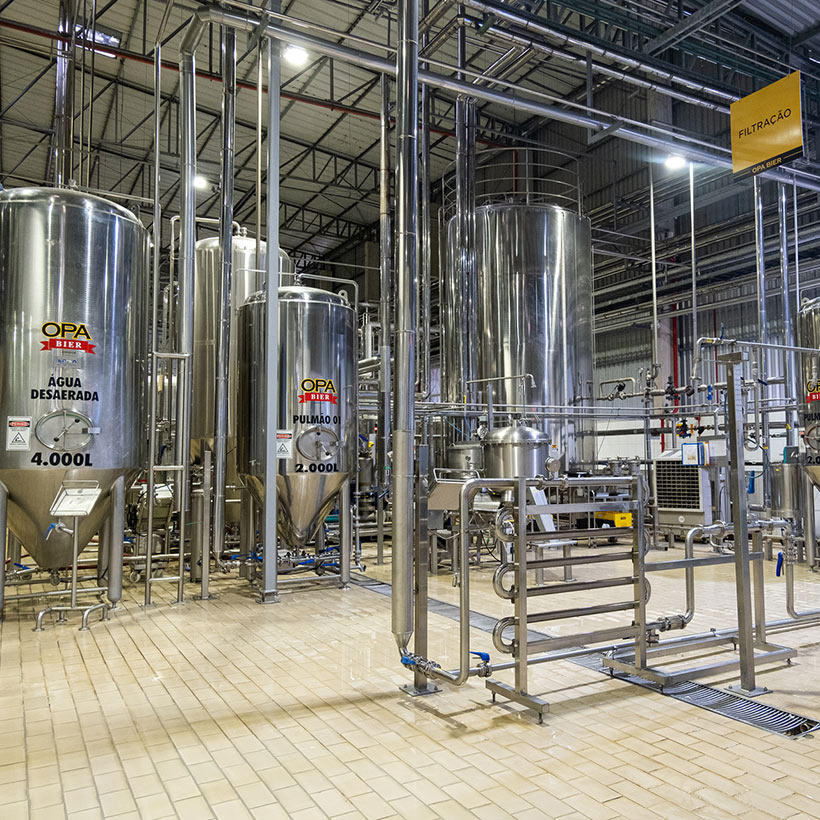
Now the beer is almost ready. After maturing, the beer goes through the filtration process, which makes it as we know it, bright and crystalline, ready to be filled into kegs, cans, or bottles. It’s worth remembering that filtration differs according to the beer style. In the case of OPA BIER Hefe Weizen, a traditional wheat beer, it does not undergo final filtration. On the other hand, OPA Kristall Weizen undergoes final filtration, resulting in a more crystalline liquid.
DID YOU KNOW: On the left you can see two tanks of deaerated water, of 4,000 liters each. Deaerated water is oxygen-free water and is used to prevent the beer from oxidizing, keeping its flavor and freshness characteristics.
Want to see how filling of beer is done? Then walk over to the Filling area and click on NEXT.
FILLING MACHINE
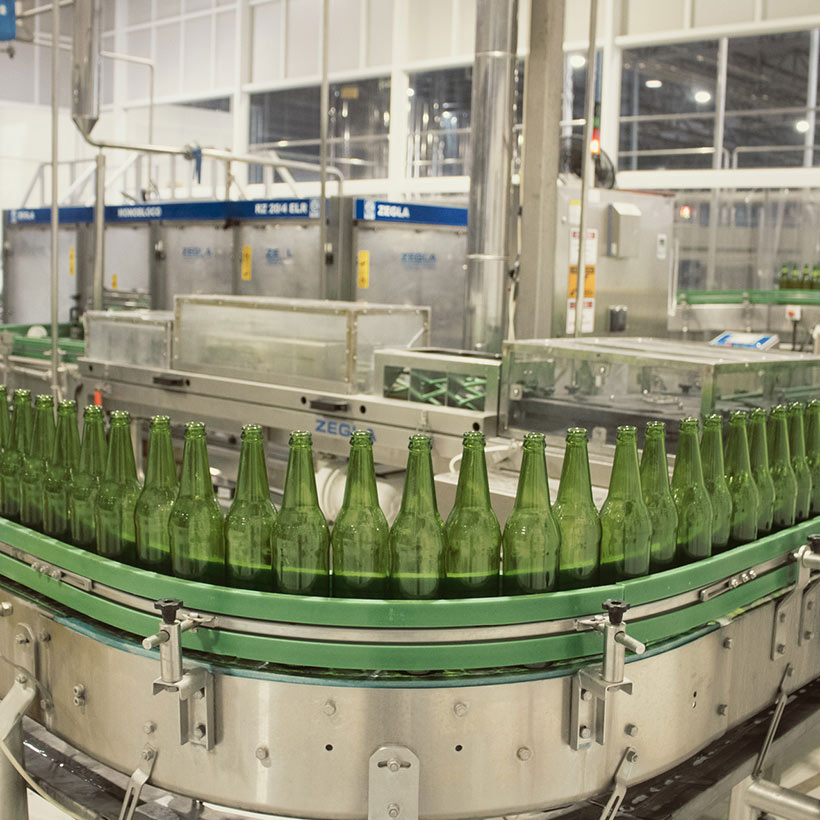
OPA BIER’s beers are filled in this area. There are two filling lines that fill and seal the packages: the aluminum can filler and the glass bottle filler. They have the capacity to fill 10,000 cans/hour or 5,000 bottles/hour. That’s more than 2.1 million liters/month of filling capacity.
When you pass through the gate, you will enter the pasteurization area. Before you click NEXT, our guides want to take a group photo. After all, you too are guardians of Joinville’s brewing tradition. Say cheese!
Click on NEXT.
PASTEURIZER
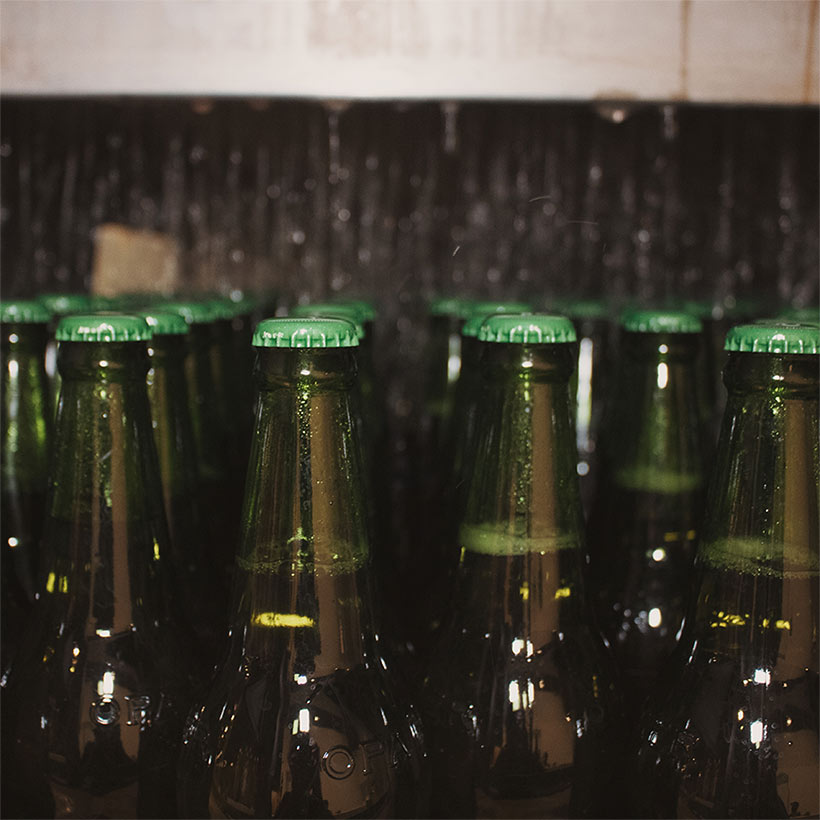
Once the beer cans and bottles have been filled, they follow a conveyor belt to a pasteurizing tunnel. The packages are gradually heated until they reach a temperature of around 60 degrees Celsius, where pasteurization occurs. This is followed by a gradual cooling. This pasteurization technique eliminates any chance of microorganisms that may still be present, ensuring that the beer has a longer shelf life and can be consumed safely.
DID YOU KNOW: Pasteurization is a microbiological stabilization process, developed in 1862 by the French chemist Louis Pasteur. To this day, the technique is widely used in food industry all over the world. What we know as draft beer, on the other hand, is beer that has not been pasteurized. For this reason, draft beer must be kept constantly refrigerated and has a shorter shelf life.
After pasteurization, cans and bottles are packaged. Click on NEXT.
PACKAGING
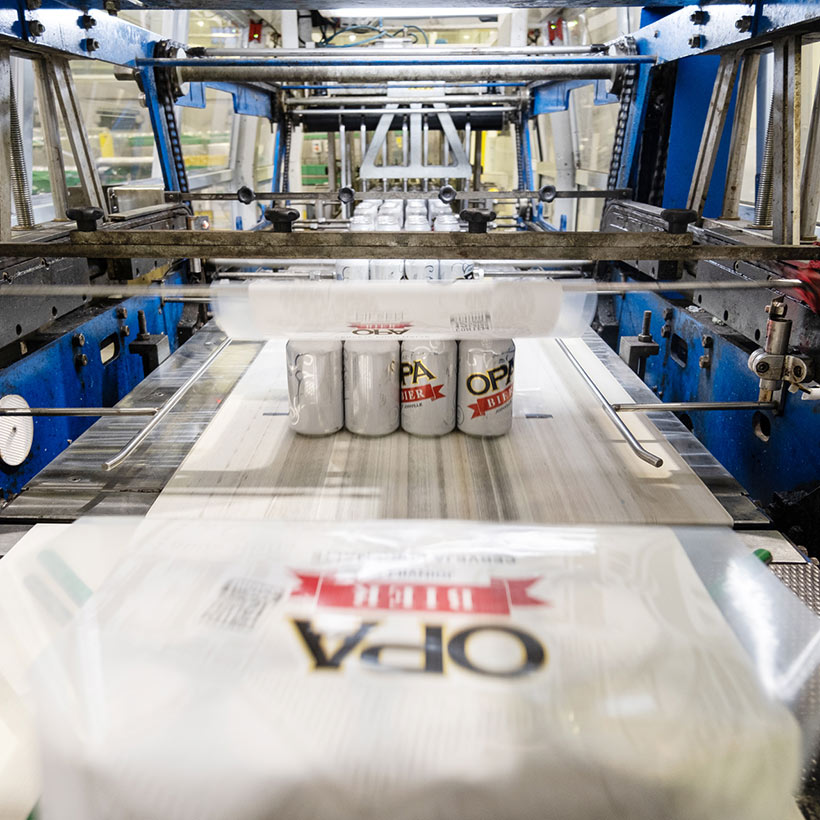
The packaging process for cans and bottles is automated at OPA BIER. The aluminum cans are packed in packs of 12 and go through a hot air tunnel, which makes the heat- shrinkable plastic mold itself to the pack of cans. On the other hand, OPA BIER bottles are packed in recyclable cardboard boxes with 12 units in each box.
Further on you can see the OPA BIER robot in action. Click on NEXT.
PALLETIZING ROBOT
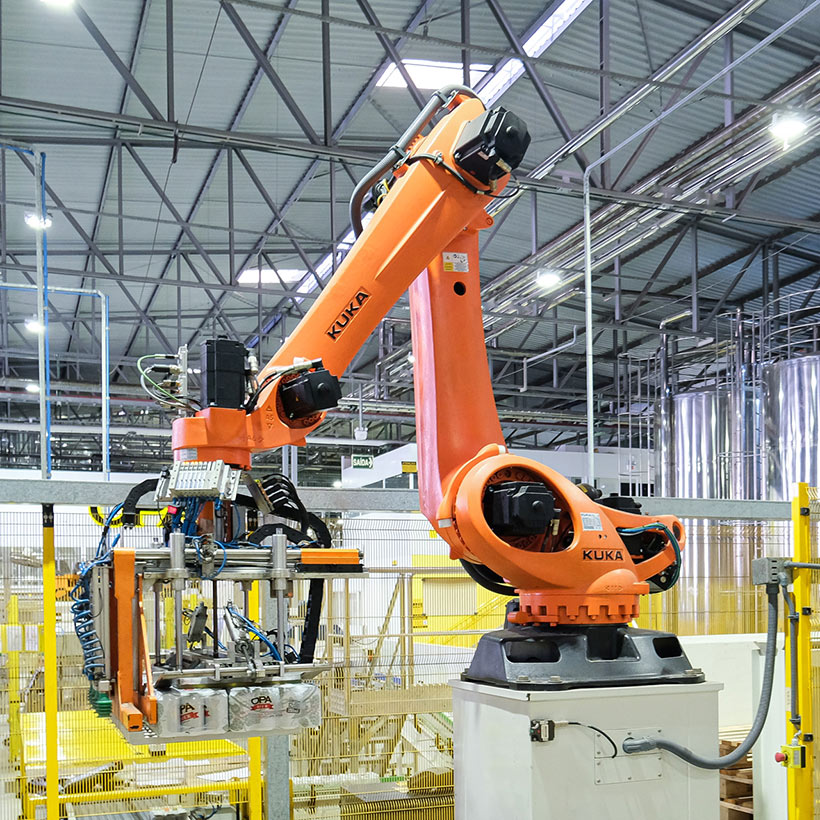
The orange mechanical arm you see is a palletizing robot. It handles high loads of beverages. At OPA, the advantages of using the German-made robot are speed and precision when palletizing production. The robot stacks the boxes on the pallet, wraps the load in stretch film and lets the packages ready to be loaded onto the trucks for deliveries. The robot packs around 10,000 cans every hour, on average. When it comes to palletizing 600ml bottles, a heavier load due to the glass packaging, Kuka handles up to 90 dozen per pallet.
DID YOU KNOW: The OPA BIER robot is a very similar model to the one that took part in the opening ceremony of the Paralympics in Rio 2016, when American model and paralympic athlete Amy Purdy, who wore mechanical prostheses on both legs, danced with a Kuka robot, showing the synergy between humans and machines, something common among amputee athletes.
Click on NEXT to continue the beer tour.
TREATMENT PLANT
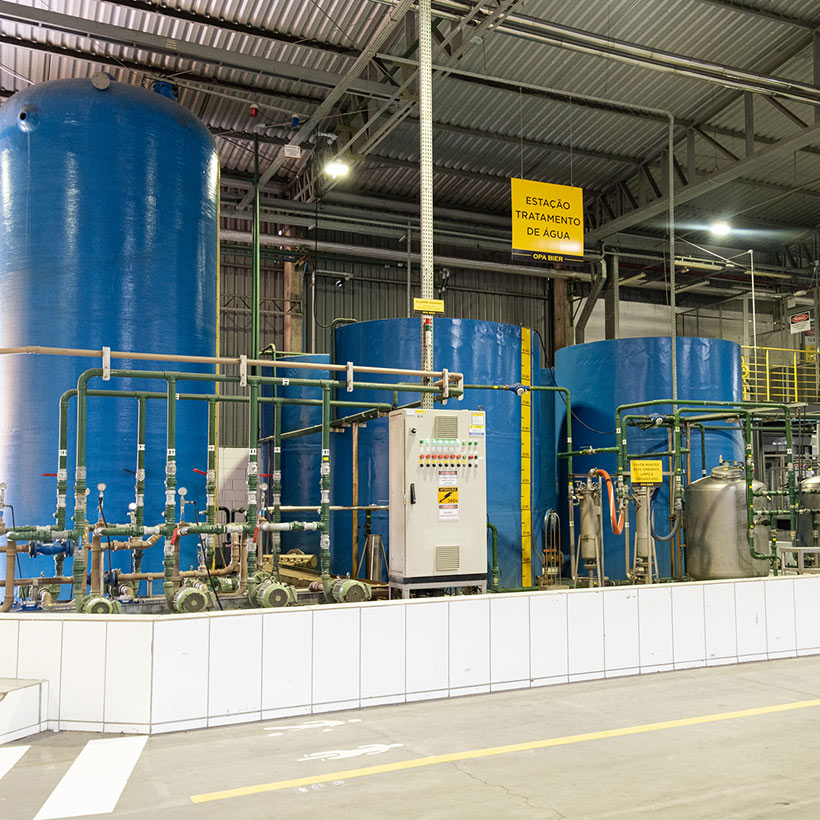
The blue tanks you see on the left are from OPA BIER’s Water Treatment Plant. Joinville’s water, so famous in the city’s brewing history, couldn’t receive better treatment. After all, more than 90% of the composition of beer is water. Here, the water is collected from deep artesian wells, where it is treated and transformed into what is known as “brewery water”, a water free of chlorine, mineral concentration and with controlled pH parameters.
DID YOU KNOW: The water treatment process is carried out in partnership with Incasa, the industry from chemical sector that monitors OPA BIER. Incasa celebrated its 70th anniversary in 2024 and water treatment is one of its specialties. At OPA BIER you can be certain: our beverages are produced with the purest water.
Click on NEXT and now look to the right!
NON-ALCOHOLIC FILLING MACHINE
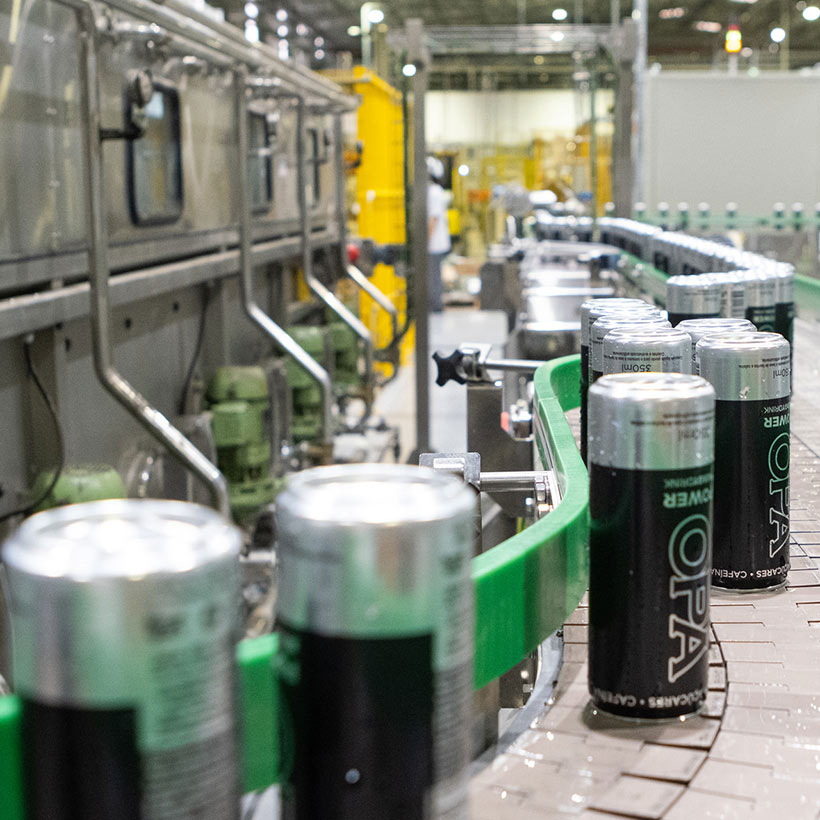
Let’s take a break from the beer to talk about the two filling areas we see on the right. The first is the aluminum can filler for soft drinks, energy drinks and carbonated waters with natural flavors. This line is the factory’s newest and started operating at the beginning of 2024. It has the capacity to fill 5,000 cans per hour or 1 million liters per month, increasing the plant’s total capacity to 3.6 million liters/month of beverages.
Just ahead is the PET packaging line. This is where OPA Power 2-liter PET energy drinks and OPA Chopão, an unpasteurized Pilsen beer sold in 1.5-liter PET bottles, are filled. This line has the capacity to fill 500,000 liters/month.
Let’s talk about beer again? Then click on NEXT!
EXPERIMENTAL MICRO AND NANO BREWERIES
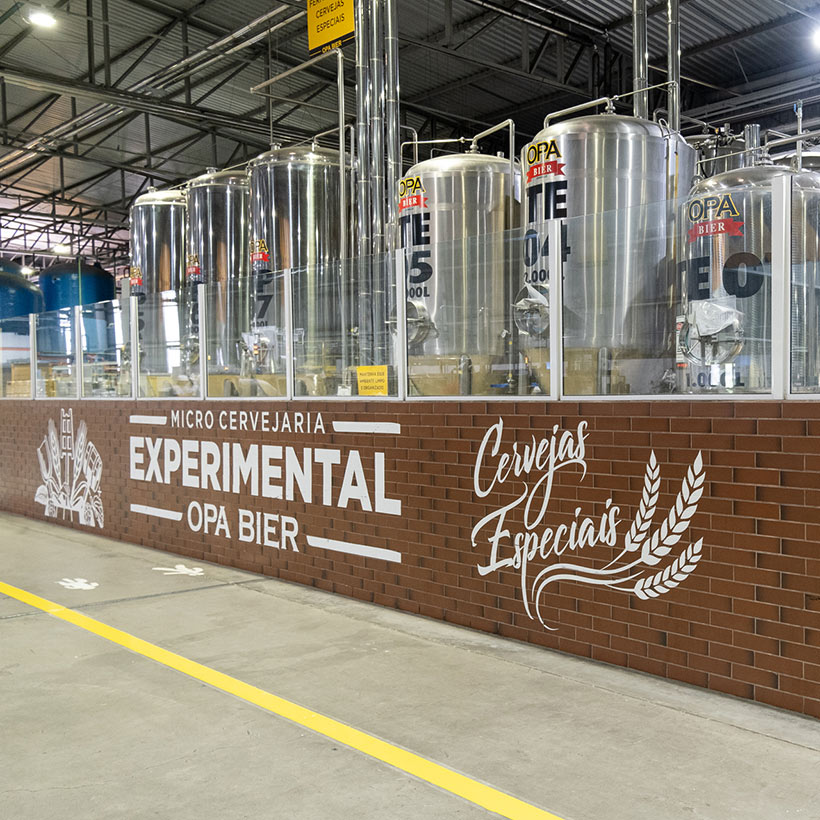
In front of PET bottling line is OPA BIER’s Experimental Microbrewery, where special beers are produced, with a smaller production volume and draft beer filled in 30 and 50- liter kegs. The microbrewery has a production capacity of 200,000 liters per month and has a mashing of 2,000 liters per cycle and fermentation and maturation tanks of 1,000, 2,000 and 4,000 liters.
Right beside it is the OPA BIER Nanobrewery, used for academic practice and formulating recipes for development.
DID YOU KNOW: The tanks and vats at the OPA BIER Microbrewery are the same used in OPA BIER’s first production line, when it opened in 2006. At that time, the OPA BIER Factory operated in a small warehouse next to the current factory. Take a good look at these tanks. They produced the first OPA BIER beers, which were initially sold only in kegs.
Now, keep going. You’ll pass a corridor with hundreds of thousands of empty aluminum cans, labels, packaging, and bottles. When you reach the wall with the painting of the hop plantation, seize to take a photo and a deep breath. Your visit is coming to the most expected time.
After the photo, click on NEXT.
TASTING
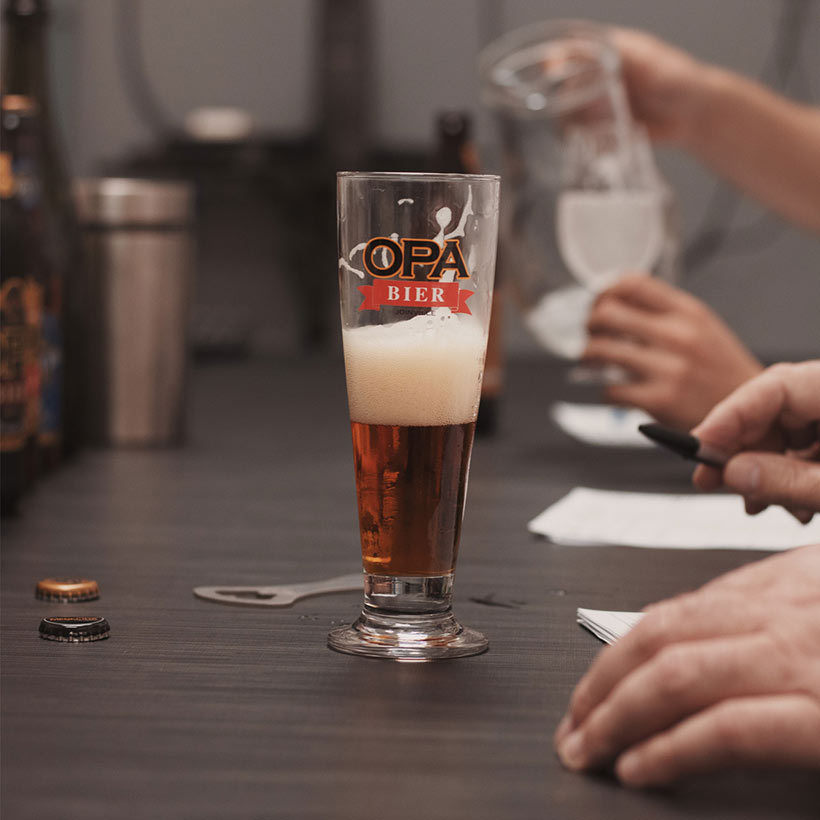
Now you’ll make your way back to the gate to the bottling area. There, you’ll find a 20,000-liter tank full of freshly brewed beer. And you can drink it straight from the source. I bet you’ve never had beer as fresh as this. So, grab your mug and enjoy this unique experience. Oh, the mug is yours. A gift from Willhem OPA! Take it with you to show your friends that you drank straight from a tank of 20,000 liters of beer during a visit to the Fantastic OPA BIER Brewery!
It was a pleasure to welcome you here. We hope you enjoyed the tour. See you next time!